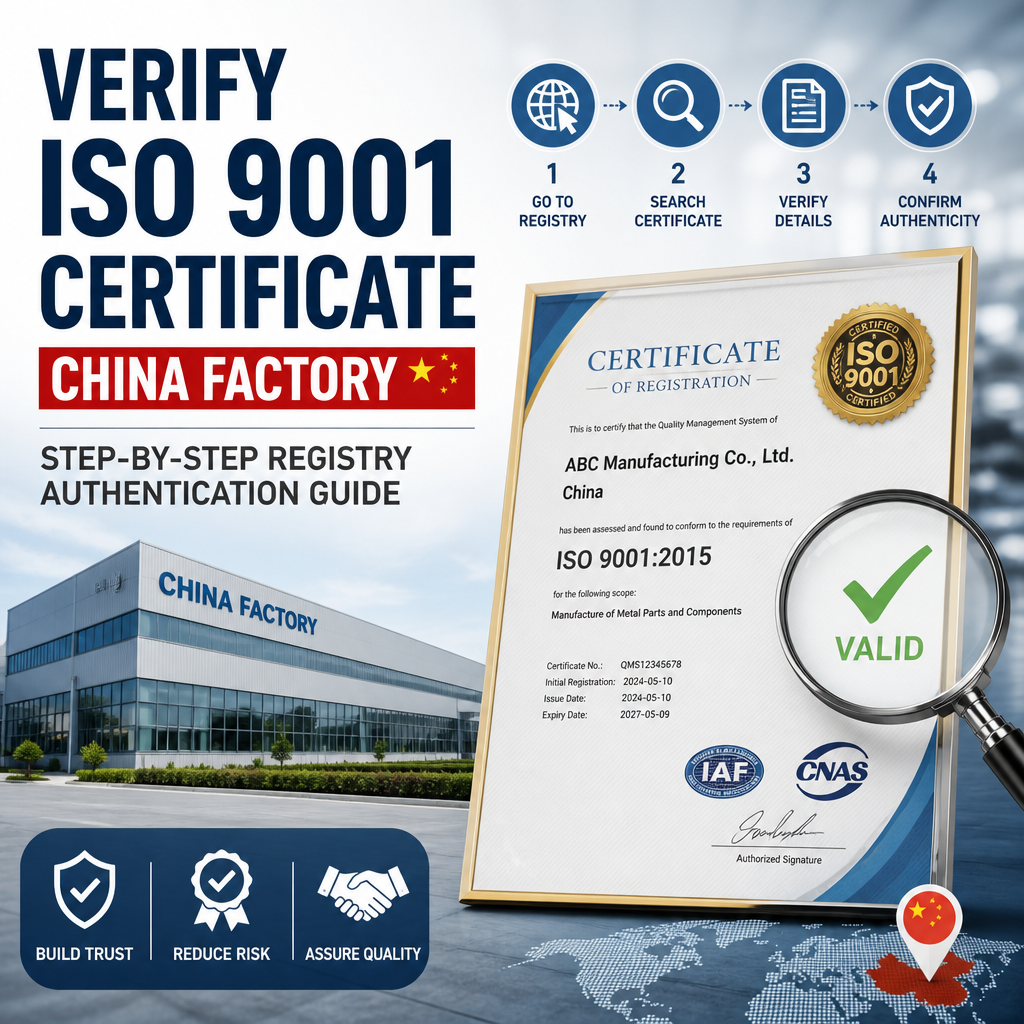
How to Read a Chinese Factory’s ISO 9001 Certificate and Verify It in the Certification Body’s Public Registry
A Chinese factory’s ISO 9001 certificate is only useful if you can confirm it is current, authentic, and issued by a real certification body with an active listing in the public registry. The fastest way to verify ISO 9001 certificate China factory claims is to compare the certificate details against the certification body’s online record, then check the factory name, scope, certificate number, issue date, and expiration date for a perfect match. This ISO certificate authentication process is essential for sourcing, supplier qualification, and procurement risk control because expired or falsified certificates are common red flags in cross-border trade.
Step-by-Step Method to Verify a Chinese Factory’s ISO 9001 Certificate

1) Check the certificate for the five fields that must match exactly
Before opening any registry, read the certificate itself and extract the core identifiers. If any of these fields are missing, altered, or inconsistent, treat the document as untrusted until proven otherwise.
| Field to check | What it should show | Why it matters |
|---|---|---|
| Certified company name | Exact legal factory or company name | The certificate must belong to the same legal entity you are buying from |
| Certificate number | A unique ID issued by the certification body | This is the easiest way to search the public registry |
| Certification body name | Full formal name of the issuing body | Determines which registry to use for authentication |
| Scope of certification | Products, processes, or services covered | Confirms the certificate actually covers your product category |
| Issue and expiration dates | Valid date range | Confirms the certificate is not expired |
2) Verify the certification body, not just the logo
A genuine ISO 9001 certificate for a Chinese factory should name a recognized certification body, such as SGS Société Générale de Surveillance SA, Bureau Veritas Certification, TÜV Rheinland, Intertek Certification Limited, or China Quality Mark Certification Group Co., Ltd. The logo alone is not proof, because counterfeit certificates often copy brand marks while inventing certificate numbers or using inactive office names.
Use the full formal name of the certification body exactly as printed on the certificate and search its official public registry or certificate validation page. If the certificate body cannot be found, does not issue ISO 9001 certificates, or has no searchable record for the certificate number, the document should be treated as suspicious.
3) Search the certification body’s public registry by certificate number
The certificate number is usually the fastest verification key. Enter the number into the issuing body’s online certificate search page and confirm the result returns the same company name, scope, and validity dates shown on the PDF or paper copy.
If the registry returns no result, try searching by:
- Company name in English and Chinese characters
- Certification body name
- Registration address
- Scope keywords such as “manufacturing,” “machining,” “electronics assembly,” or “plastic injection”
A mismatch between the certificate and registry record is a strong sign of a falsified or altered document.
4) Confirm the factory name and address are identical across all records
This step matters because many suppliers reuse certificates from affiliated entities, trading companies, or separate branches. The legal name on the ISO 9001 certificate must match the factory’s actual registered entity, not just a similar trade name or sales office.
Pay close attention to:
- Chinese legal name versus English translation
- Parent company versus subsidiary
- Factory site address versus office address
- Branch office wording such as “site,” “plant,” or “division”
If the registry lists a different address, a different company registration number, or a narrower production site than the one quoted by the supplier, ask for clarification before proceeding.
5) Check the scope of certification against your sourcing category
ISO 9001 is a quality management system certificate, not a product approval certificate. That means a factory may be certified for “metal fabrication” but not necessarily for the exact item you are sourcing, such as precision components, food-contact packaging, or medical device accessories.
Use the scope statement to answer one question: does the certified process actually cover the item you are buying? If not, the certificate may still be valid, but it does not prove the supplier is certified for your product category or production line.
6) Confirm the certificate is still active and has not been suspended or withdrawn
A certificate can appear real but still be inactive. The public registry should show current status, often marked as active, valid, suspended, or withdrawn.
If the registry status is unclear, contact the certification body directly and ask for:
- Current certificate status
- Renewal date
- Suspension history
- A verification letter or authenticity confirmation
For high-value sourcing decisions, a current registry record is stronger than a PDF alone because it proves the certificate is being maintained in the certification body’s live system.
7) Cross-check with the factory through an independent channel
Do not rely only on the supplier’s sales contact. Ask the factory to provide the certificate in the same naming format that appears in the registry, then verify the result using a second channel such as the certification body’s official customer service email or telephone line.
Useful buyer-side request:
- “Please send the ISO 9001 certificate PDF and the exact registry link from the issuing certification body.”
- “Please confirm the certificate number, company legal name, and expiration date in writing.”
- “Please provide the test or audit scope if the factory produces multiple product categories.”
This reduces the risk of doctored screenshots and outdated renewals.
8) Watch for common falsification signals
Counterfeit certificates often reveal themselves through small details. The most common warning signs include:
- Misspelled certification body names
- Unusually generic company names
- Missing certificate number
- No expiration date
- Poor-quality logos or blurred seals
- Scope text copied from another industry
- Dates that do not align with registry results
- A certificate body that does not maintain a public validation page
If two or more warning signs appear together, treat the certificate as unverified until the certification body confirms it.
9) Keep a supplier file with your verification evidence
For procurement compliance, save the certificate copy, registry screenshot, verification email, and date of confirmation in your supplier record. This creates an audit trail for sourcing teams, quality managers, and customs or import documentation reviews.
A clean verification file should contain:
- Certificate copy
- Registry result page
- Certification body contact record
- Notes on scope and validity
- Date and name of the staff member who performed verification
That evidence helps you defend supplier selection decisions during quality disputes, customer audits, or supply chain risk reviews.
Why ISO 9001 Certificate Authentication Matters in China Sourcing
It reduces supplier fraud risk
A verified ISO 9001 certificate tells you the factory has passed an external audit under a recognized quality management system. Without registry authentication, the document may be nothing more than a marketing claim.
It improves procurement confidence
When the supplier name, scope, and validity period all match the public registry, buyers can shortlist suppliers faster and reduce unnecessary back-and-forth. That is especially valuable when comparing contract manufacturers, OEM suppliers, and export-oriented factories.
It supports quality and compliance checks
ISO 9001 does not guarantee product quality by itself, but it does show that the factory has documented processes, corrective action systems, and management review discipline. For importers, that creates a stronger foundation for factory audits, sample approval, and production control.
It strengthens sourcing due diligence
For B2B buyers, the real value of ISO certificate authentication is not the piece of paper; it is the proof that the factory has a traceable, active quality system under a real certification body. That makes it a practical risk-screening tool for supplier onboarding and ongoing vendor monitoring.
FAQ
How can I quickly verify ISO 9001 certificate China factory documents?
Check the certificate number, certification body name, factory legal name, scope, and expiration date, then search the issuing body’s public registry for an exact match. If the registry record does not match, the certificate should be treated as unverified.
Does an ISO 9001 certificate prove the factory makes high-quality products?
No. ISO 9001 proves the factory has a quality management system, but you still need product-specific checks such as factory audits, sample testing, and scope verification for your exact item.
What should I do if the certificate looks real but is not in the registry?
Ask the supplier for an updated certificate and contact the certification body directly for confirmation. If the issuing body cannot confirm the certificate number and status, do not rely on the document for sourcing approval.
The safest sourcing practice is simple: never accept an ISO 9001 certificate at face value when buying from a Chinese factory. Verify the certificate against the certification body’s public registry, confirm the legal entity and scope, and save proof of your ISO certificate authentication in your supplier file. That one workflow can eliminate a large share of preventable procurement risk before a purchase order is ever issued.
Leave a Reply