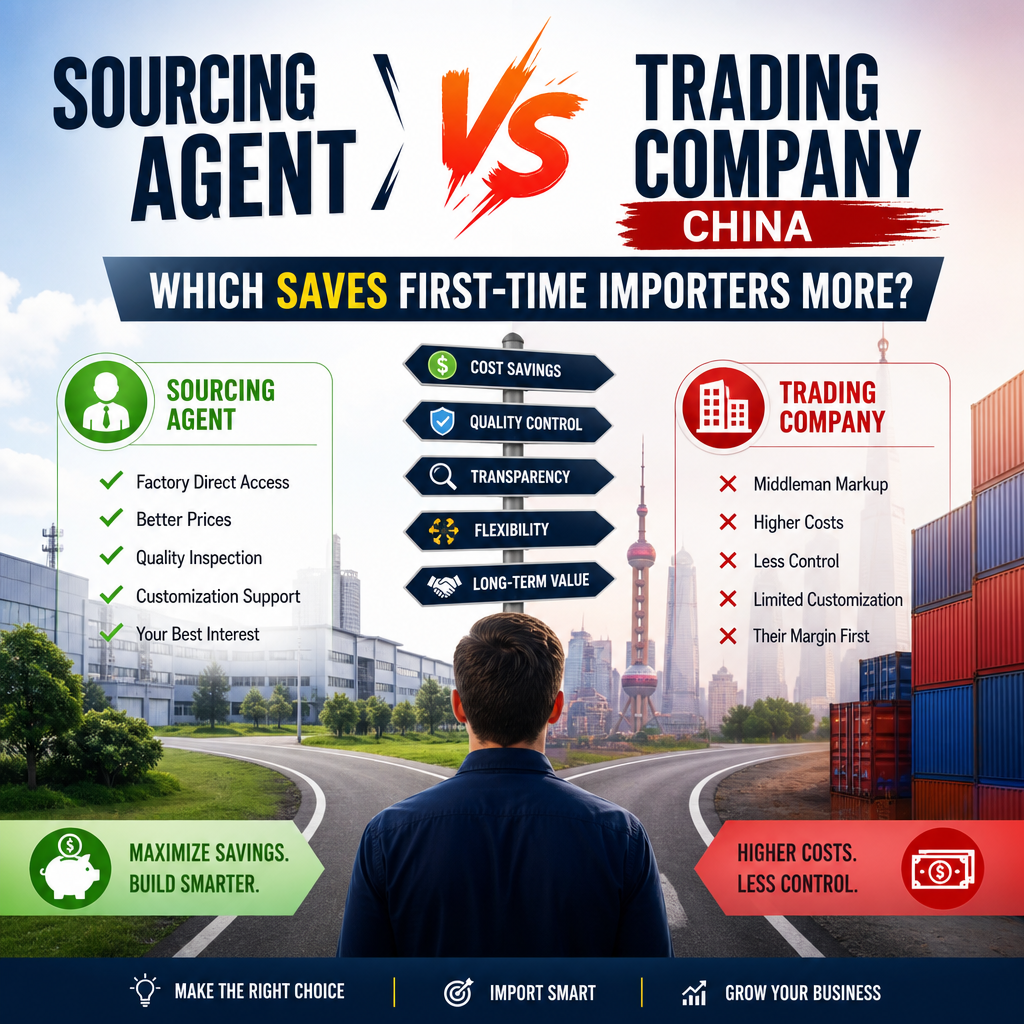
Sourcing Agent vs Trading Company China: Which One Saves a First-Time Importer More Money?
For a first-time importer placing a mid-size order from Chinese manufacturers, a sourcing agent usually saves more money on the total landed cost if you already know the product spec and need factory-direct pricing, inspection support, and negotiation help. A trading company is often the better choice when you value speed, simpler communication, mixed-product purchasing, and lower execution risk, even if the unit price is higher. In other words, the cheapest quote is not always the cheapest import outcome; the real answer in a China import cost comparison depends on product complexity, order size, quality risk, and how much sourcing work you can manage yourself.
Sourcing Agent vs Trading Company China: The Practical Difference for Importers

What a sourcing agent does
A sourcing agent is a procurement service provider that helps buyers find Chinese manufacturers, request quotes, verify factories, negotiate terms, coordinate samples, and often support quality control and shipping coordination. Because the sourcing agent is usually paid by service fee, commission, or a project-based arrangement, the buyer can often reach closer to factory pricing and avoid hidden markups on the product itself.
For a first-time importer, this matters because a sourcing agent can reduce cost leakage caused by:
- choosing the wrong factory
- overpaying through intermediaries
- approving poor samples
- missing quality issues before shipment
- accepting unfavorable payment or Incoterms terms
What a trading company does
A trading company is a commercial intermediary that buys from manufacturers and resells to the importer under its own invoice. Trading companies often simplify procurement because they can bundle multiple products, handle documentation, and respond quickly with ready-to-ship or production-linked offers.
This solves a different buyer problem: instead of building factory relationships from scratch, the importer buys a more managed package. The tradeoff is that the trading company typically builds its margin into the product price, which can raise the unit cost even if the process feels easier.
Why this difference changes your total cost
The core cost difference is simple:
- Sourcing agent model: lower product price, separate service cost
- Trading company model: higher product price, services embedded in markup
For a mid-size order, the cheaper option depends on whether the agent’s service fee is smaller than the trading company’s markup after you account for defects, delays, sample waste, and rework. A lower ex-factory price only wins if the factory is actually reliable and the product meets spec the first time.
China Import Cost Comparison: Which Option Usually Saves More on a Mid-Size Order?
Best choice by buyer situation
| Buyer situation | Better option | Why it usually wins on cost |
|---|---|---|
| Clear product spec, repeatable order, and willingness to manage communication | Sourcing agent | Factory-direct pricing usually lowers unit cost and gives more control over negotiation, packaging, and inspection |
| Multiple SKUs, mixed products, or urgent timeline | Trading company | One vendor can consolidate purchasing and reduce coordination cost, even if the per-unit price is higher |
| First-time importer with limited China experience but decent time to manage the project | Sourcing agent | The biggest savings come from avoiding expensive mistakes and buying from the right factory |
| First-time importer with no bandwidth for supplier vetting or follow-up | Trading company | The convenience premium can be worth it when the risk of delays or miscommunication is high |
Where the money is actually won or lost
A mid-size order is large enough for pricing differences to matter, but not so large that every factory will offer its best direct rate. That makes the comparison practical:
-
Product unit price
- A sourcing agent can often reduce unit cost by reaching manufacturers directly.
- A trading company may add margin, especially for standard goods with easy resale value.
-
Sampling and revision cost
- A sourcing agent can reduce sample waste by aligning the buyer with the right factory earlier.
- A trading company may move faster, but the buyer may pay more per iteration.
-
Quality risk
- A sourcing agent can arrange factory audits or third-party checks, helping prevent expensive rejects.
- A trading company can be safer for inexperienced buyers if it has established QC routines, but that safety is not free.
-
Communication and admin cost
- A trading company usually saves time by acting as a single point of contact.
- A sourcing agent saves money when the buyer is prepared to manage decisions and approve details quickly.
-
Logistics and consolidation
- A trading company is useful when you need combined shipments, mixed cartons, or multiple factory orders under one invoice.
- A sourcing agent is better when you want to preserve factory pricing and optimize freight separately.
Direct answer: who saves more money?
For most first-time importers buying a mid-size order from Chinese manufacturers, a sourcing agent usually saves more money if the buyer can manage the process carefully and the product is not highly complex. The reason is that factory-direct procurement often produces a lower landed cost than an intermediary resale model, especially when the order is big enough to justify agent fees but not so large that the buyer can staff an in-house China sourcing team.
However, a trading company can be the lower-risk financial choice when the hidden cost of mistakes would exceed the markup. If your product requires fast consolidation, uncertain specifications, or heavy coordination, the trading company may reduce total project cost even when the invoice price is higher.
Best decision rule for first-time importers
Use this rule:
- Choose a sourcing agent when your priority is lowest landed cost, factory transparency, and direct negotiation
- Choose a trading company when your priority is speed, convenience, and simpler execution
- Choose the option that reduces your total landed cost, not just the quoted unit price
For sourcing agent vs trading company China decisions, the first-time importer usually gets the best savings by combining a sourcing agent with an independent quality inspection and freight quote comparison. That structure keeps factory pricing close to direct levels while protecting against the most common cost overruns in China sourcing.
Closing takeaway
A sourcing agent generally delivers the stronger cost advantage on a mid-size order from Chinese manufacturers, but only when the buyer uses the agent to reach the right factory and maintain control over quality. A trading company can still be the smarter choice when execution risk, speed, and bundled service matter more than the lowest invoice price. For a first-time importer, the winning strategy is to compare the full landed cost, not just the supplier quote, because that is where the real savings in China import cost comparison are decided.
Leave a Reply